

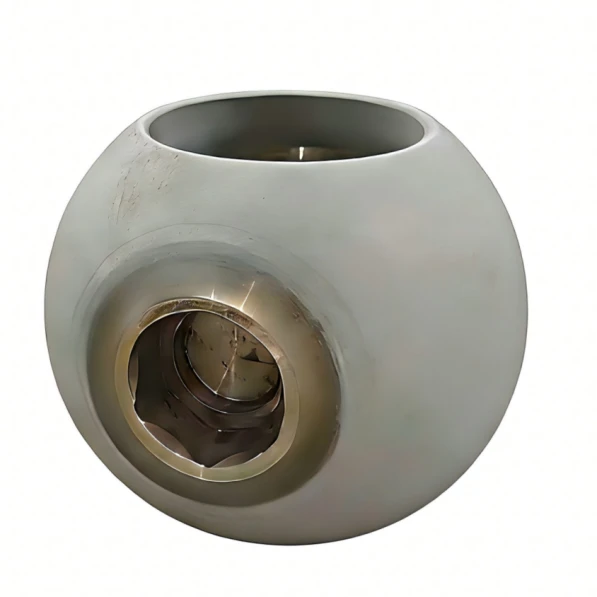

| Chromium Carbide-Nickel Chromium Coated Valve Balls | ||
| Size Range | 1/2" to 56" (Custom sizes available) | |
| Pressure Rating | PN10-PN420 (Class150-2500) | |
| Body Material | A105, A350 LF2, A182 F304, A182 F316, A182 F321, A182 F51, A182 F53, A182 F55, A182 F60, A182 F44, A564 630 (17-4PH) INCONEL625, INCONEL718, INCONEL825, Monel 400, Monel 500 etc |
|
| Core Process/Coating | ENP,HCR,STL6, STL12, STL20,Cr3C2, WC-Co, WC-Cr3C2-Ni, TiC-NiMo, SiC, CrC,ZrO2, Al2O3, Cr2O3, ZnO, TiO, Al2O3-TiO2,STL1, STL6, STL12,Ni60, Ni55, Ni45 etc. | |
| Operating Temperature Range | ≤1200°C | |
| Parameter Category | Core Technical Parameters | Standards for Determining Advanced Technological Level |
| Machining ball accuracy | ≤ 0.025 mm | ≤ 0.005 mm (Ultra-High Precision) |
| Processing ball Roundness | ≤ 0.025 mm | ≤ 0.011 mm (Micron-Level ) |
| Balls concentricity | ≤ 0.025 mm | ≤ 0.005 mm (Ultra-High Precision) |
| Other supplements | ≤ 0.4 μm | ≤ 0.1 μm (Mirror-Level) |
| Parameter Category | Core Technical Parameters | Criteria for High-End Technical Level |
| Coating Thickness Control | Thickness Uniformity | Thickness deviation at any spherical position ≤±8% (stricter than the general ±10% standard) |
| Thickness Tolerance Range | 100 - 300 μm (common range for wear-resistant layers); special ranges can be noted. No missed spraying for ultra-thin coatings (<10μm) | |
| Coating Adhesion Performance | Surface Hardness | HV 1300+ |
| Bond StrengthBond Strength | ≥80 MPa | |
| Interface PorosityInterface Porosity | <0.5% | |
| Coating Surface Quality | Surface Roughness (Ra) | ≤0.2 µm |
| Spraying Accuracy (Positioning & Coverage) | Spraying Positioning Accuracy | ±0.1mm |
Core Products: High-Performance Coatings Designed for High-Temperature Oxidizing Wear
Chromium Carbide (Cr₃C₂) is renowned among metal carbides for its excellent high-temperature oxidation resistance and good wear resistance, while the Nickel-Chromium (NiCr) alloy binder phase provides toughness and corrosion protection.
Defining the Wear Resistance Standard Above 540°C
Unlike tungsten carbide coatings, which can undergo significant oxidation and softening above approximately 500°C, our Chromium Carbide-Nickel Chromium Coated valve Balls excel in the temperature range of 540°C to 900°C. The Cr₃C₂-NiCr coating (Cr3C2-NiCr coating ball) maintains high hardness and structural stability over prolonged periods, making it the preferred solution for combating particle erosion in high-temperature flue gas, hot air, boiler soot blowing, and certain high-temperature process media.
Superior Combination of High-Temperature Oxidation & Corrosion Resistance
The core advantage of Chromium Coated valve Balls lies in their "self-protection" mechanism. The chromium within the coating rapidly forms a dense Cr₂O₃ protective film in high-temperature oxidizing atmospheres. This film is extremely stable at high temperatures, effectively preventing further inward diffusion of oxygen to erode the coating body and substrate. Simultaneously, the NiCr binder phase itself offers good resistance to hot corrosion and gas corrosion, ensuring comprehensive performance in complex industrial atmospheres.

Resisting Moderate to Severe Abrasive Wear
Although slightly less hard than tungsten carbide, chromium carbide coating hardness still far exceeds that of most metal alloys, sufficient to handle moderate to severe abrasive wear. Our Hard coated ball products effectively resist the scouring and cutting action of solid particles like fly ash, catalysts, and mineral sand at elevated temperatures, significantly extending valve service life in critical locations such as fluid catalytic crackers, utility boilers, and cement kiln inlets.
Complete Surface Engineering Solution
The Chrome carbide coated ball we provide is not an isolated product but a complete solution encompassing substrate selection, coating design, spray application, and post-treatment. We can optimize the ratio of chromium carbide to nickel chromium and the coating thickness based on the valve's actual operating temperature, media corrosiveness, and wear severity, precisely matching the service requirements in the most economical way.

Technical Focus: Precision Empowerment of High-Temperature Coating Performance via Plasma Spray
To obtain a uniform, dense, and strongly bonded chromium carbide coating on the complex curvature of a valve ball, we employ Atmospheric Plasma Spraying (APS) as the core process.
Complete Melting of High-Temperature Particles Ensures Intrinsic Coating Properties:
The plasma arc generates ultra-high temperatures exceeding 10,000°C, sufficient to completely melt the Cr₃C₂-NiCr powder particles. These molten particles impact the substrate at high velocity, flatten, and rapidly solidify, forming a tightly bonded coating primarily with a lamellar structure, maximizing the material's high-temperature hardness and oxidation resistance potential.
Precise Control of Oxidation & Phase Transformation Ensures Long-Term Coating Stability:
During spraying, we minimize the oxidation degree of powder particles by precisely controlling the plasma gas composition, flow rate, and spray environment. This ensures the content and morphology of the hard Cr₃C₂ phase in the coating, preventing premature softening due to excessive oxidation forming softer Cr₂O₃, thereby guaranteeing the coating's performance stability during long-term high-temperature service.
Post-Coating Treatment Optimization Enhances Surface Quality & Bond Strength:
For applications with special requirements, we can perform post-spray treatments like remelting (e.g., laser remelting) or Hot Isostatic Pressing (HIP) on the Cr₃C₂-NiCr coating ball. This further eliminates inter-lamellar porosity, increases coating density and bond strength, and results in a smoother, more uniform coating surface, reducing media flow resistance and fouling tendency.
Why Choose TongBall's Chromium Carbide-Nickel Chromium Coating Solution?
Targeted Expert for High-Temperature Wear Conditions:
We deeply understand the irreplaceability of chromium carbide coatings in high-temperature oxidizing environments. Our solution is not a general-purpose wear coating but is specifically designed for the core challenges of "high temperature" and "oxidation".
Seasoned Master of Plasma Spray Technology:
We possess years of experience in Atmospheric Plasma Spraying, enabling fine control over this complex process to ensure the microstructure and macro-performance of every batch of Chromium Carbide-Nickel Chromium Coated Valve Balls are optimal and consistent.
Bridge Focused on Connecting Theory with Industrial Practice:
We understand not only the laboratory data of materials but also pay close attention to their long-term performance in real industrial environments (e.g., temperature fluctuations, atmosphere changes, start-stop cycles). Our process design aims to ensure the coating delivers its theoretical lifespan in practical use.
Seeking a Reliable Solution in Environments Where High Temperature and Oxidation Coexist with Wear
If your valves face lifespan challenges in high-temperature flue ducts, thermal systems, or wear environments with oxidizing atmospheres, a surface solution that simultaneously addresses high-temperature hardness and oxidation resistance is crucial. TongBall's Chromium Carbide-Nickel Chromium Coating Technology provides a proven engineering answer for these specific yet vital operating conditions.
Hot Tags: chromium carbide-nickel chromium coated valve balls, China chromium carbide-nickel chromium coated valve balls manufacturers, factory, Inconel Coated Balls, Thermal shock resistant YSZ coated valve ball, Industrial valve ceramic coated ball, Alumina Coated valve Balls, Chromium Nitride Coated valve Balls, YSZ coated valve ball


